
Agentic AI Comparison:
Amoeba vs Autonomous Field Mapper
 vs
vs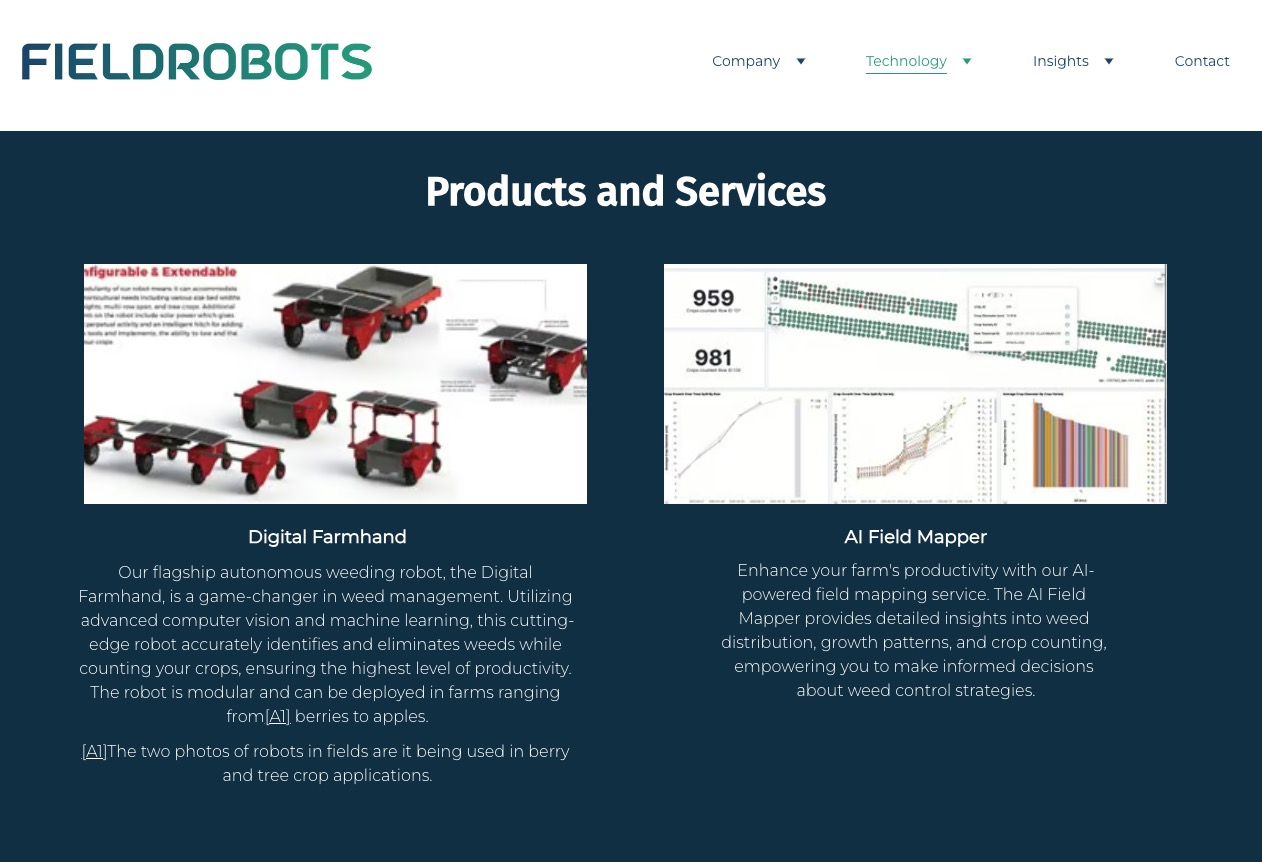
Introduction
This report compares Autonomous Field Mapper and Amoeba across autonomy, ease of use, flexibility, cost, and popularity. Autonomous Field Mapper is best understood as an autonomous physical-world mapping system for agricultural or industrial fields, while Amoeba is an agentic AI platform aimed at GTM and data-driven business workflows. The scores below are relative judgments on a 1-10 scale, where higher means better performance on the named metric.
Overview
Autonomous Field Mapper
Autonomous Field Mapper is a robotics- and software-centric solution for automatically surveying and mapping physical fields using sensors, GPS, cameras, and AI-based autonomy. It is designed for precision agriculture and other outdoor operational settings where the system can navigate complex terrain, collect spatial data, and generate maps with minimal human intervention.
Amoeba
Amoeba is an agentic AI company focused on going beyond automated workflows to support data-driven insights for go-to-market teams.[A] Its public materials emphasize agentic AI, orchestration across workflows, and partnerships intended to strengthen business intelligence and operational decision-making.[B][C]
Metrics Comparison
autonomy
Amoeba: 7
Amoeba is described as an agentic AI platform that goes beyond automated workflows, indicating meaningful software autonomy in task execution and workflow coordination.[B] However, its autonomy is applied to business processes rather than physical-world navigation and sensing, so it is less autonomous in the operational sense used for field mapping.[B][C]
Autonomous Field Mapper: 10
Autonomous Field Mapper is explicitly built to perform automatic surveying and mapping of physical environments with minimal human intervention, which is the core meaning of autonomy in this context. Its use of sensors, GPS, cameras, and AI-based navigation supports high autonomy in unstructured outdoor settings.
Autonomous Field Mapper has stronger end-to-end autonomy because it operates in the physical world with limited human oversight, whereas Amoeba’s autonomy is primarily digital and workflow-oriented.[B]
ease of use
Amoeba: 8
Amoeba is positioned as a business AI platform for GTM teams, which suggests a software-first product that is generally easier to adopt than robotics systems.[B][C] Its focus on workflows and insights implies usability for non-robotics users, though enterprise AI platforms can still require some implementation effort.[B][C]
Autonomous Field Mapper: 4
Autonomous field mapping systems typically require robotics infrastructure, sensor setup, and specialized operational planning, which makes them technically complex and less approachable for casual users. Their use in outdoor environments also implies more configuration and domain expertise than a standard software tool.
Amoeba is likely easier to use for the average business team, while Autonomous Field Mapper is more specialized and operationally demanding.[B]
flexibility
Amoeba: 8
Amoeba appears more flexible as a software platform for agentic workflows and data-driven insights, which can adapt across GTM use cases and business processes.[B][C] Its partnership-oriented positioning also suggests extensibility and application across multiple operational contexts.[C]
Autonomous Field Mapper: 6
Autonomous Field Mapper is flexible within its domain because it can support mapping, surveying, and field analytics across outdoor settings such as agriculture and industrial sites. Still, it is constrained by its dependence on physical environments and specialized hardware, which limits cross-domain flexibility.
Amoeba is more flexible across business workflows, while Autonomous Field Mapper is flexible mainly within physical mapping and outdoor operations.[B][C]
cost
Amoeba: 6
Amoeba is a software-based AI platform, which generally lowers hardware and deployment costs relative to robotics systems.[B][C] However, enterprise AI products can still involve licensing, configuration, and integration costs, so it is not necessarily low-cost in an absolute sense.[B][C]
Autonomous Field Mapper: 3
Autonomous Field Mapper likely has higher cost because it depends on robotics, sensors, GPS, cameras, and field deployment infrastructure. A robotics-based field mapping solution also tends to require maintenance, integration, and specialized operations, all of which increase total cost.
Amoeba is likely the lower-cost option overall because it is software-centric, while Autonomous Field Mapper incurs hardware and field-deployment expenses.[B][C]
popularity
Amoeba: 5
Amoeba appears to be a newer or less widely established AI company, and the provided sources emphasize product positioning and partnerships rather than broad market penetration.[B][C] Its audience is narrower than mass-market software, but it may still have growing visibility in AI and GTM circles.[B][C]
Autonomous Field Mapper: 4
Autonomous field mapping is a specialized niche with adoption concentrated in agriculture, industrial surveying, and related outdoor operations. The category is technically important but not broadly mainstream, which suggests moderate to low general popularity.
Neither option appears broadly mainstream, but Amoeba likely has slightly stronger general visibility because it operates in the fast-growing agentic AI market rather than a highly specialized robotics niche.[B][C]
Conclusions
Autonomous Field Mapper is the stronger choice for physical-world autonomy and field-level precision, especially when the goal is automated surveying and mapping in outdoor environments. Amoeba is stronger on ease of use, flexibility, and likely cost efficiency for business workflows, making it better suited to software-driven GTM and analytics use cases.[B][C] If the decision is between robotics-based field operations and agentic business software, the right option depends on whether the primary need is physical mapping or digital workflow intelligence.[B][C]
The best framework is the one that finishes your task tomorrow too.
Run OpenClaw or Hermes with saved memory, monitored restarts, clear costs, and the messaging channel you already use.
Plans start at $29/month. Cancel anytime.
Hosted agent
OpenClaw or Hermes