
Agentic AI Comparison:
Autonomous Field Mapper vs Hex
 vs
vs
Introduction
This report compares the Autonomous Field Mapper technology from FieldRobots with Hex, a modern data workspace offering notebooks and AI-assisted analytics. The comparison focuses on autonomy, ease of use, flexibility, cost, and popularity, using available technical descriptions and product overviews as the basis for evaluation.
Overview
Hex
Hex is a collaborative analytics and data science workspace that combines cloud notebooks, workflow orchestration, and an AI assistant (Magic AI) to help analysts explore data, build reports, and share interactive applications.[hex.tech][hex.tech/product/notebooks][hex.tech/product/magic-ai] It offers a browser-based notebook interface, SQL and Python support, integrations with common data warehouses, and features for publishing dashboards and apps to stakeholders.[hex.tech/product/notebooks] Magic AI provides AI-assisted code generation, analysis, and explanations to speed up development and lower barriers for less-technical users.[hex.tech/product/magic-ai]
Autonomous Field Mapper
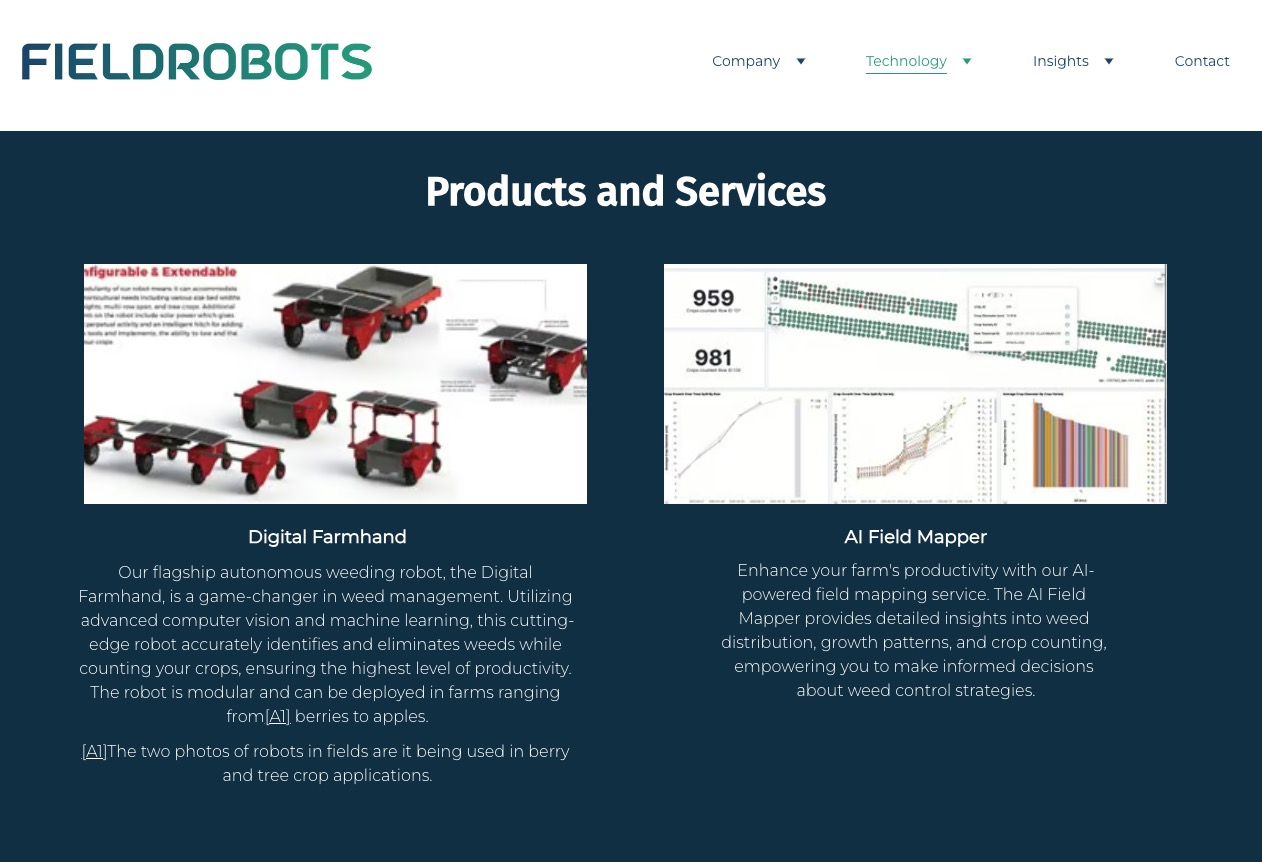
Autonomous Field Mapper refers to FieldRobots' agricultural robotics technology that performs autonomous navigation and mapping in fields, using sensors, proximity sensing, and robotics control to generate detailed field maps and support precision agriculture operations. It is designed to reduce manual scouting and mapping workload in farms, improving efficiency and data quality in agricultural environments. The system typically relies on GPS, vision or LiDAR-like sensing, and onboard autonomy software to traverse crop fields, detect terrain features, and build maps that can be used for subsequent operations such as spraying or harvesting.
Metrics Comparison
autonomy
Autonomous Field Mapper: 9
FieldRobots' Autonomous Field Mapper is designed to navigate and map agricultural fields with minimal human intervention, leveraging autonomous navigation and proximity sensing to localize itself and build maps in outdoor, unstructured environments. Research on autonomous field mapping in agriculture highlights that such systems are capable of handling localization, mapping, and obstacle avoidance in real time, indicating a high level of operational autonomy for field tasks.
Hex: 6
Hex provides some automation and assistance through features like Magic AI, which can automatically generate code, suggest analyses, and create visualizations based on user prompts.[hex.tech/product/magic-ai] However, Hex remains a human-driven analytics platform where users initiate queries, configure notebooks, and design workflows, so its autonomy is primarily in assisting user decisions rather than executing physical or fully automated end-to-end processes.[hex.tech/product/notebooks]
Autonomous Field Mapper exhibits high physical and operational autonomy in real-world agricultural environments, whereas Hex focuses on AI-assisted decision support and analytic automation within a human-centered workflow. As a result, the autonomy rating is significantly higher for Autonomous Field Mapper than for Hex.[hex.tech/product/magic-ai]
ease of use
Autonomous Field Mapper: 6
Autonomous Field Mapper systems in agriculture usually require configuration of robot hardware, sensors, and mapping parameters, and they are operated by technically capable farm staff or specialists. While the goal is to reduce manual labor and simplify field mapping, setup, calibration, and maintenance of autonomous robots can be complex, and interpreting field maps may demand agronomic or technical expertise, which modestly limits ease of use for non-specialists.
Hex: 8
Hex is explicitly designed to be user-friendly for data analysts, offering a web-based notebook interface, SQL and Python support, rich documentation, and guided workflows.[hex.tech/product/notebooks] Magic AI further improves ease of use by helping users write queries, generate code, and build analyses via natural language, which lowers the barrier to entry for less experienced users.[hex.tech/product/magic-ai] Collaboration features and sharable apps also streamline sharing and consumption of results for non-technical stakeholders.[hex.tech]
Hex generally provides a more accessible software experience for typical business and analytics users than an agricultural autonomous robot does for farm operators, even though both aim to simplify complex tasks. Therefore, Hex scores higher on ease of use due to its browser-based interface, AI assistance, and collaborative features.[hex.tech/product/notebooks][hex.tech/product/magic-ai]
flexibility
Autonomous Field Mapper: 7
Autonomous Field Mapper technologies are flexible within agricultural contexts, as autonomous mapping systems can be adapted to different crop types, field layouts, and tasks such as scouting, spraying, or harvesting support. However, their functional scope is largely confined to field operations and precision agriculture, and repurposing them outside this domain would require substantial modification of hardware and software, which limits broader flexibility.
Hex: 9
Hex supports a wide range of analytical use cases, including exploratory data analysis, reporting, dashboarding, data apps, and machine learning workflows across many industries.[hex.tech][hex.tech/product/notebooks] Users can connect to different data sources, write SQL and Python code, integrate external libraries, and use notebooks for varied tasks. Magic AI adds further flexibility by helping users quickly prototype and adapt analyses based on prompts, making Hex suitable for diverse, changing data workflows.[hex.tech/product/magic-ai]
Autonomous Field Mapper is flexible within the agricultural domain, adapting to different field operations and conditions, but Hex is more broadly flexible across multiple industries and analytical tasks due to its general-purpose notebook and AI capabilities. Consequently, Hex receives a higher flexibility score.[hex.tech/product/notebooks]
cost
Autonomous Field Mapper: 5
Autonomous field robots typically involve significant upfront investment in hardware, sensors, and integration, along with ongoing maintenance and potential field support costs. While they can reduce labor and improve efficiency over time, the capital expenditure for autonomous mapping platforms and associated equipment is generally high compared to purely software solutions, which lowers their relative cost score despite long-term savings in some scenarios.
Hex: 7
Hex is a SaaS analytics platform, and its main costs are subscription fees rather than large physical hardware investments.[hex.tech] Cloud-based deployment allows customers to scale usage according to needs, and companies can avoid substantial upfront capital associated with building on-premises infrastructure. Although enterprise software licenses can be expensive, the cost profile is typically more accessible and flexible than acquiring specialized autonomous robots.[hex.tech/product/notebooks]
Autonomous Field Mapper likely requires higher capital and operational expenditure due to specialized hardware and field deployment, while Hex mainly incurs recurring software subscription costs. Even though precise pricing details vary by deployment, Hex is assigned a higher cost score based on the lower barrier to entry and more scalable cost structure typical of cloud analytics platforms.[hex.tech]
popularity
Autonomous Field Mapper: 4
Autonomous field mapping robots represent an emerging niche within precision agriculture, with research and pilot deployments increasing but widespread commercial adoption still in early stages. Compared to mainstream farm machinery, autonomous field mappers currently have limited installed base and relatively narrow market penetration, which leads to a lower popularity score despite growing interest in smart agriculture technologies.
Hex: 8
Hex is part of a well-known category of modern analytics and data science platforms used across technology, finance, and other sectors, and it markets itself as a collaborative analytics workspace with a rapidly growing user base.[hex.tech] Its focus on notebooks, cloud-native collaboration, and AI features places it among popular tools adopted by data teams seeking alternatives to legacy BI and notebook solutions, indicating higher market visibility and usage.[hex.tech/product/notebooks]
While autonomous field mapping robots are gaining traction within precision agriculture, their usage remains relatively limited compared with broadly adopted data analytics platforms. Hex benefits from a wider potential audience and stronger presence in the analytics tooling ecosystem, resulting in a significantly higher popularity score.[hex.tech]
Conclusions
Autonomous Field Mapper from FieldRobots and Hex serve very different domains: the former delivers high physical autonomy and specialized field mapping for precision agriculture, whereas the latter offers a flexible, user-friendly analytics environment augmented by AI assistance. Autonomous Field Mapper excels in autonomy and domain-specific capabilities, making it suitable for farms seeking to automate field scouting and mapping tasks. Hex, on the other hand, leads in ease of use, flexibility, cost profile, and popularity due to its browser-based notebooks, integrations, and Magic AI features that support many analytic workflows across industries.[hex.tech][hex.tech/product/notebooks][hex.tech/product/magic-ai] Organizations should choose between them based on whether their primary need is autonomous agricultural field operations or collaborative data analysis and reporting in a cloud-native environment.
The best framework is the one that finishes your task tomorrow too.
Run OpenClaw or Hermes with saved memory, monitored restarts, clear costs, and the messaging channel you already use.
Plans start at $29/month. Cancel anytime.
Hosted agent
OpenClaw or Hermes