
Agentic AI Comparison:
Autonomous Field Mapper vs TextQL
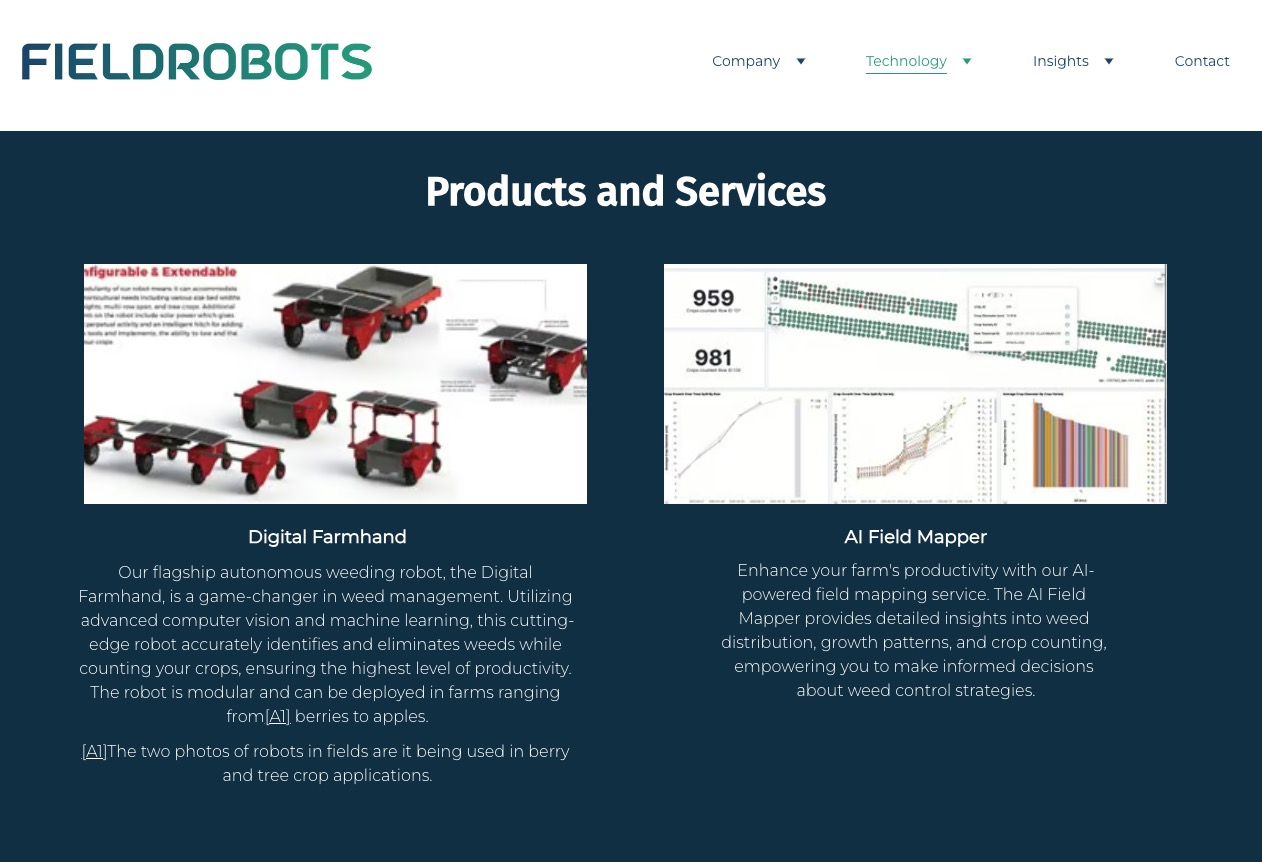 vs
vs
Introduction
This report compares Autonomous Field Mapper systems (as represented by advanced autonomous agricultural/industrial field‑mapping robotics and software in the FieldAI/field‑robots category) with TextQL, an AI‑powered, natural‑language business intelligence and data exploration platform. The comparison focuses on five metrics—autonomy, ease of use, flexibility, cost, and popularity—to highlight how a robotics‑centric, physical‑world mapping solution differs from a cloud‑based, text‑driven analytics tool in capabilities, user experience, and adoption.
Overview
TextQL
TextQL is an AI‑driven analytics and business intelligence platform that allows users to query, explore, and visualize data using natural language, without writing SQL or complex code.[textql.com/product/ai][textql.com] It focuses on making data‑driven decision‑making accessible to non‑technical users by translating text queries into structured operations on databases and data warehouses, generating charts, dashboards, and insights.[textql.com/product/ai][textql.com/category/artificial-intelligence] TextQL emphasizes ease of use, collaboration, and integration with existing business data ecosystems, acting as a cloud‑based assistant that sits on top of digital data rather than controlling physical systems.[textql.com][textql.com/product/ai] Its strengths are in rapid BI prototyping, self‑service analytics for teams, and lowering the barrier to data exploration, with typical SaaS pricing and a broader potential user base among knowledge workers and business analysts.[textql.com/product/ai][textql.com/category/artificial-intelligence]
Autonomous Field Mapper
Autonomous Field Mapper refers to robotic and software systems that perform automatic surveying and mapping of physical fields (e.g., agricultural land, industrial sites, mines, or forests) using sensors, GPS, cameras, and AI‑based autonomy. These systems typically integrate embedded autonomy software with mobile robots or UAVs that can navigate unstructured outdoor environments, collect spatial and environmental data (soil properties, crop health, terrain, structures), and generate detailed maps with minimal human intervention. Their primary value lies in precision agriculture, resource optimization, and operational planning, enabling farmers, agronomists, and industrial operators to manage large areas efficiently and safely. However, they require specialized hardware, technical setup, and domain expertise, making them a niche but high‑impact solution for organizations that need autonomous field‑scale data collection and mapping.
Metrics Comparison
autonomy
Autonomous Field Mapper: 9
Autonomous Field Mapper systems are explicitly designed for high physical‑world autonomy: robots or UAVs navigate real‑world fields, avoid obstacles, follow GPS‑guided paths, collect sensor data, and build maps with limited human intervention. Research on autonomous field mapping and agricultural robots highlights advanced localization, mapping, and operation capabilities that function under uncertainty in unstructured outdoor environments. In mining, forestry, and agriculture, autonomous mapping platforms (e.g., UAVs with photogrammetry or autonomous drones like Hovermap) operate with significant autonomy in hazardous or hard‑to‑reach areas, further demonstrating high autonomy in physical tasks. While some configuration and supervision are needed, the core navigation and mapping workflows are heavily automated, justifying a very high autonomy score.
TextQL: 6
TextQL provides software‑level autonomy for digital data workflows: it automatically interprets natural‑language questions, generates appropriate data queries, and returns visualizations or insights without users writing SQL or code.[textql.com/product/ai][textql.com] This represents meaningful cognitive and workflow automation, as the system takes on query formulation, chart selection, and sometimes insight extraction.[textql.com/product/ai][textql.com/category/artificial-intelligence] However, TextQL does not autonomously act in the physical world, nor does it execute operational decisions; it operates as a recommendation and analytics layer that still depends on user‑initiated questions and human judgment.[textql.com/product/ai] Therefore, its autonomy is moderate in the digital analytics domain but substantially lower than robotics systems that physically navigate and map environments.
On autonomy, Autonomous Field Mapper significantly outperforms TextQL in physical‑world autonomy, since it controls robots/UAVs that autonomously navigate and map complex outdoor or industrial environments. TextQL shows moderate autonomy in data query and visualization generation, automating cognitive tasks but remaining reactive to user input within digital systems.[textql.com/product/ai][textql.com/category/artificial-intelligence] Overall, Autonomous Field Mapper is far more autonomous in operational terms, while TextQL offers lighter, software‑centric autonomy for knowledge work.[textql.com/product/ai]
ease of use
Autonomous Field Mapper: 5
Autonomous Field Mapper solutions are powerful but technically demanding: deploying robots or UAVs requires hardware procurement, calibration, field safety procedures, regulatory compliance (e.g., UAV rules), and configuration of mapping software and sensors. Operators typically need training in robotics, precision agriculture, or GIS to plan missions, interpret maps, and integrate data into farm or industrial workflows. Although modern systems aim to simplify operation with user‑friendly interfaces and automated flight paths, the overall complexity of field robotics, environmental variability, and maintenance leads to a moderate ease‑of‑use rating rather than high simplicity.
TextQL: 9
TextQL is explicitly designed to be easy to use, enabling non‑technical users to ask questions about their data in plain language instead of writing SQL or complex queries.[textql.com/product/ai][textql.com] The platform emphasizes intuitive, text‑driven interfaces, guided query suggestions, and automatic generation of charts and dashboards, lowering the barrier to data exploration for business users.[textql.com/product/ai][textql.com/category/artificial-intelligence] As a cloud‑based SaaS product, setup typically involves connecting data sources rather than installing specialized hardware, and everyday use resembles chatting with an AI assistant.[textql.com/product/ai] This design focus on accessibility and minimal technical prerequisites supports a very high ease‑of‑use score.
On ease of use, TextQL strongly outperforms Autonomous Field Mapper: TextQL focuses on a conversational, natural‑language interface for querying existing business data, making it approachable for non‑technical users.[textql.com/product/ai][textql.com] Autonomous Field Mapper systems, by contrast, involve robotics hardware, environmental constraints, and specialized mapping workflows that require domain expertise, training, and operational planning. For typical users, TextQL offers near‑frictionless onboarding, while Autonomous Field Mapper remains more complex and suited to professional operators in agriculture, mining, or similar fields.[textql.com/product/ai]
flexibility
Autonomous Field Mapper: 7
Autonomous Field Mapper systems exhibit strong flexibility within physical mapping contexts: they can be adapted to different field geometries, crops, terrains, and industrial sites, and can mount various sensors (RGB cameras, multispectral sensors, LiDAR, proximity sensors, magnetic field probes) to capture different types of spatial and environmental data. Research and industry solutions highlight use cases ranging from precision agriculture and forestry to mining and magnetic field mapping, indicating that the core mapping autonomy can be repurposed across domains with appropriate hardware and software configuration. Nonetheless, their flexibility is constrained to physical‑world surveying and mapping; they are not general‑purpose tools for arbitrary digital data tasks or business workflows, limiting flexibility relative to broad software platforms.
TextQL: 8
TextQL is flexible in the digital analytics space, as it can be connected to multiple data sources (databases, data warehouses, business metrics) and answer a wide array of natural‑language questions, generating different visualizations and reports as needed.[textql.com/product/ai][textql.com] Its AI layer interprets varied query structures, supports many business domains (sales, marketing, operations, finance), and scales with evolving datasets and metrics.[textql.com/category/artificial-intelligence] The platform is, however, focused on structured data exploration and BI workflows; it does not directly handle robotics control, unstructured spatial mapping, or heavily specialized scientific sensing tasks.[textql.com/product/ai] Within knowledge‑work environments, this breadth of data use cases yields high flexibility, though it remains bounded by business analytics rather than physical operations.
In flexibility, the comparison is domain‑dependent: Autonomous Field Mapper is highly flexible within physical mapping and sensing, adapting to diverse terrains, crops, and industrial environments through different robots/UAVs and sensor payloads. TextQL is highly flexible within digital data analytics, connecting to various data sources and answering many types of business questions across functions.[textql.com/product/ai][textql.com/category/artificial-intelligence] TextQL edges ahead overall because business analytics spans more everyday organizational scenarios than specialized autonomous field mapping, yet Autonomous Field Mapper remains more flexible for organizations needing sophisticated spatial data collection.[textql.com/product/ai]
cost
Autonomous Field Mapper: 4
Autonomous Field Mapper implementations typically involve significant upfront and ongoing costs: purchasing or leasing robots/UAVs, high‑quality sensors (multispectral cameras, LiDAR, GNSS), maintenance, field operations, and specialized software licenses for photogrammetry or robotics control. Agricultural and mining autonomy solutions are often capital‑intensive investments, justified by increased productivity, reduced labor, and better decision‑making but still relatively expensive compared to purely software tools. Additional costs may include training personnel, complying with UAV regulations, and integrating mapping outputs into existing farm or industrial management systems. These factors collectively support a lower cost score, reflecting high total cost of ownership despite long‑term value.
TextQL: 7
TextQL is delivered as a cloud‑based AI analytics product, with a typical SaaS pricing model that charges per seat, usage, or tier.[textql.com][textql.com/product/ai] There is no requirement for specialized hardware; organizations mainly pay subscription fees and possibly higher tiers for advanced features or larger data volumes.[textql.com/product/ai] Compared to robotics and autonomous mapping systems, this represents a substantially lower barrier to entry and smaller capital expenditure, although enterprise‑scale deployments or large user bases can still yield meaningful recurring costs.[textql.com] Overall, TextQL offers relatively cost‑effective access to advanced analytics capabilities, yielding a mid‑to‑high cost score.
On cost, TextQL is considerably more affordable and accessible than Autonomous Field Mapper solutions: it is a software‑only, subscription‑based service with no need for specialized physical hardware or field operations.[textql.com][textql.com/product/ai] Autonomous Field Mapper systems involve substantial capital investment in robots or UAVs, advanced sensors, maintenance, and specialized software, as well as operational expenditures for deployment and personnel. Consequently, Autonomous Field Mapper has a lower cost score (higher expense), while TextQL is more cost‑effective for most organizations seeking analytics capabilities rather than physical mapping.[textql.com/product/ai]
popularity
Autonomous Field Mapper: 5
Autonomous field mapping and related robotics technologies are gaining traction in precision agriculture, forestry, and mining, supported by research and commercial solutions that highlight their transformative potential. However, adoption remains relatively niche compared to mainstream enterprise software, concentrated among large farms, agribusinesses, industrial operators, and research institutions that can invest in robotics and autonomy. Public awareness of autonomous field mapping is limited outside these sectors, and the user base is smaller and more specialized than typical business productivity or analytics tools. This pattern supports a mid‑range popularity score: growing and impactful but not yet broadly adopted across general knowledge‑worker populations.
TextQL: 7
TextQL operates in the rapidly expanding AI and business intelligence space, which is widely adopted across industries.[textql.com/category/artificial-intelligence][textql.com] While TextQL itself is one among many AI‑powered analytics platforms, its focus on natural‑language querying and democratized data access aligns with widely recognized trends in modern BI, increasing its relevance and potential user base.[textql.com/product/ai] As a SaaS offering targeting business teams, its popularity is likely higher than niche robotics systems, because knowledge‑worker tools can spread across many organizations and departments with relatively low friction.[textql.com] Nonetheless, it competes in a crowded market of BI and AI analytics products, so its popularity is moderate‑to‑high rather than near‑universal.
For popularity, TextQL benefits from operating in a mainstream software category—AI‑driven BI and analytics—that targets broad business audiences and is relatively easy to adopt, yielding higher potential usage across many organizations.[textql.com][textql.com/category/artificial-intelligence] Autonomous Field Mapper systems, in contrast, serve specialized sectors like agriculture, mining, and forestry, with higher technical and financial barriers and a smaller, domain‑specific user base. As a result, TextQL attains a higher popularity score, reflecting broader applicability and easier dissemination across typical enterprises, while Autonomous Field Mapper remains impactful but niche.[textql.com/product/ai]
Conclusions
Autonomous Field Mapper and TextQL address fundamentally different problem spaces, and their strengths reflect these domains.[textql.com/product/ai] Autonomous Field Mapper systems excel in high‑autonomy physical‑world operations, using robots or UAVs to navigate, sense, and map complex outdoor or industrial environments for precision agriculture, resource optimization, and safety‑critical surveying. This autonomy and domain‑specific flexibility come at the cost of greater technical complexity, higher capital expenditure, and more niche adoption among organizations that require detailed spatial data. TextQL, by contrast, focuses on democratizing digital data analytics: it offers high ease of use, strong flexibility within business intelligence, lower cost barriers, and broader popularity among knowledge workers by enabling natural‑language queries over existing data sources.[textql.com/product/ai][textql.com/category/artificial-intelligence] When choosing between them, organizations should consider whether their primary need is autonomous physical field mapping and environmental sensing, in which case Autonomous Field Mapper is more appropriate, or accessible, AI‑driven analysis of digital business data, where TextQL provides greater value.[textql.com/product/ai]
The best framework is the one that finishes your task tomorrow too.
Run OpenClaw or Hermes with saved memory, monitored restarts, clear costs, and the messaging channel you already use.
Plans start at $29/month. Cancel anytime.
Hosted agent
OpenClaw or Hermes