
Agentic AI Comparison:
Autonomous Field Mapper vs Vanna AI
 vs
vs
Introduction
This report compares two specialized agents—Autonomous Field Mapper, a robotics-focused field mapping system, and Vanna AI, a developer-first text-to-SQL/SQL-agent framework—across five dimensions: autonomy, ease of use, flexibility, cost, and popularity. The goal is to clarify their strengths and trade-offs for prospective adopters in data, analytics, and robotics contexts.
Overview
Autonomous Field Mapper
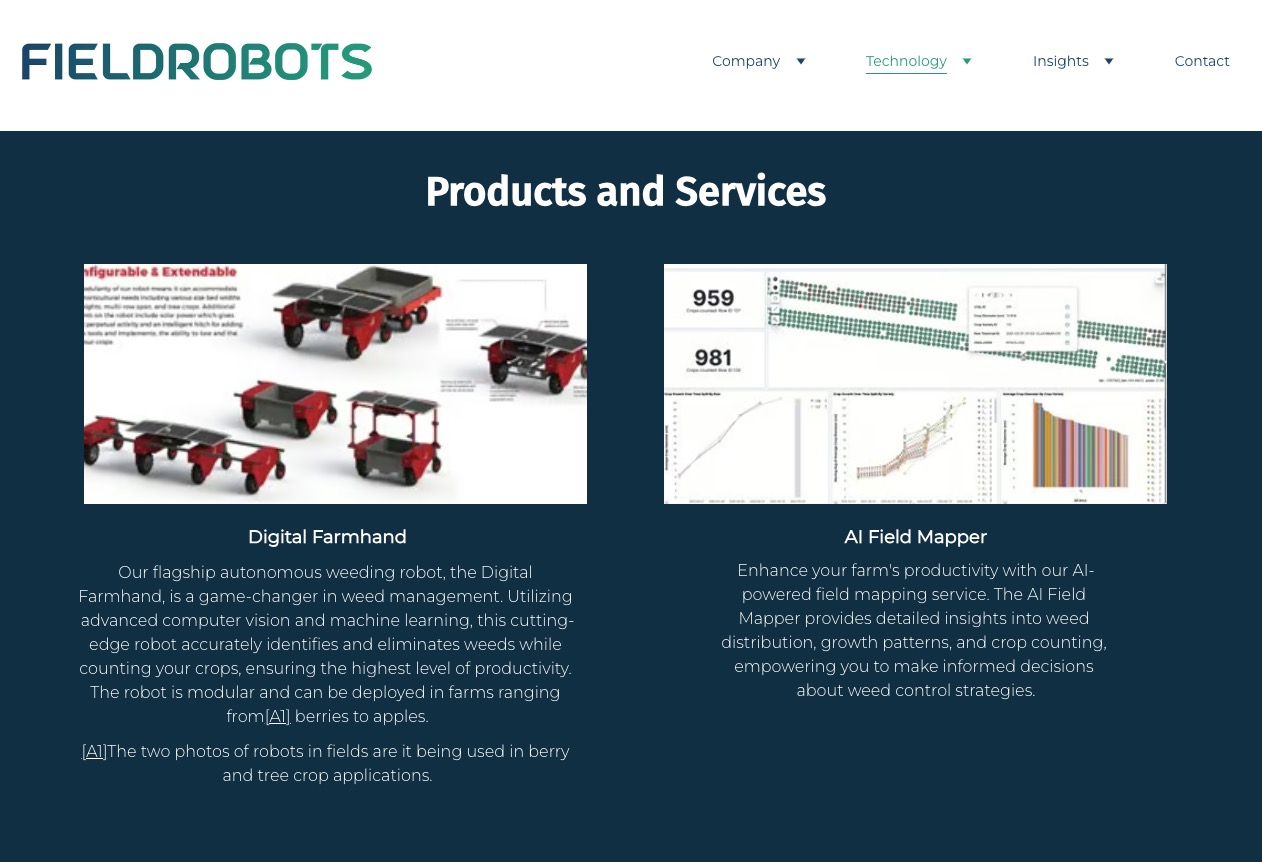
Autonomous Field Mapper is a robotics agent designed for physical field operations, such as autonomously traversing and mapping agricultural or outdoor environments. It focuses on high physical autonomy: navigating in real-world conditions, collecting spatial and sensor data, and producing maps or field coverage outputs with minimal human intervention. Its strengths lie in robotics-specific autonomy and field robustness rather than general-purpose software accessibility or broad business analytics.
Vanna AI
Vanna AI is an open-source, Python-first text-to-SQL and SQL-agent framework built for developers who want to embed natural-language-to-SQL functionality into custom applications. Vanna trains a retrieval model on a database schema, documentation, and example queries, then uses retrieval-augmented generation (RAG) to produce SQL from natural language questions. Modern Vanna 2.0 positions itself as a user-aware SQL agent framework with tool memory, multi-turn workflows, access control, observability, audit logs, hosted vector memory, and support for multiple LLM providers and databases. It is primarily aimed at technical teams who can integrate a library into their stack, not at non-technical end-users directly.
Metrics Comparison
autonomy
Autonomous Field Mapper: 9
According to agent comparison summaries, Autonomous Field Mapper is explicitly described as stronger in physical autonomy, excelling at robotics-specific field operations in real environments. Its core function is to autonomously navigate and map fields, which requires local decision-making, path planning, obstacle handling, and continuous sensor-driven operation without constant human supervision. This type of autonomy is high in the physical/robotic sense: once configured, the agent can operate over large areas with limited human control, making its autonomy score very high for its domain.
Vanna AI: 7
Vanna AI provides a software agent that automates the generation of SQL queries from natural language and can be embedded into workflows as a semi-autonomous data query engine. Vanna 2.0 includes multi-turn behavior, tool memory, user identity, access control, and auditability, allowing it to act as an autonomous SQL agent within well-defined boundaries. However, it relies on developers to design prompts, guardrails, orchestration, and execution semantics, and governance and determinism are largely the developer's responsibility. It does not autonomously explore data or self-orchestrate tasks beyond the text-to-SQL and workflow patterns defined by its integrators. This yields solid autonomy as a software component, but not at the level of fully autonomous physical or fully autonomous analytical agents.
Autonomous Field Mapper demonstrates high physical autonomy, continuously operating in real-world environments with minimal human intervention, which justifies a higher autonomy score in the robotics sense. Vanna AI demonstrates workflow autonomy in generating and managing SQL queries within applications, especially with Vanna 2.0’s tool memory and multi-turn workflows, but it remains constrained to software orchestration and requires explicit engineering design for guardrails and governance. As a result, Autonomous Field Mapper scores higher for autonomy in its primary context (field robotics), while Vanna AI offers strong but domain-limited autonomy as a developer-controlled SQL agent.
ease of use
Autonomous Field Mapper: 5
Autonomous Field Mapper is reported to be strong in physical autonomy but to lag in accessibility and broad applicability, being suited primarily to robotics-specific field operations. Physical deployment of a field robot typically requires hardware setup, environment-specific calibration, safety protocols, and operational expertise, which raises the barrier to entry compared with purely software tools. The solution is not positioned as a simple self-service analytics product, but as a specialized robotics system; this specialization and required domain expertise reduce overall ease of use for average users.
Vanna AI: 7
Vanna AI is described as an open-source Python library that can be installed trivially via pip and quickly integrated into code ("pip install vanna" and you're done). Multiple sources emphasize that Vanna is lightweight, straightforward for developers, and suitable for rapid prototypes and internal analytics applications. However, Vanna is developer-first: non-technical users cannot simply use Vanna without a custom interface, and governance, guardrails, and production readiness must be engineered by a technical team. For developers, this makes it relatively easy to use; for business users, usability depends entirely on the wrappers and interfaces those developers build. Therefore its ease-of-use score is high for technical teams but not maximal overall.
Autonomous Field Mapper’s ease of use is constrained by robotics deployment complexity, environmental setup requirements, and its focus on field operations, which makes it accessible mainly to specialized teams. Vanna AI, by contrast, is simple to install and integrate for Python developers, with clear architecture and good fit for prototypes. Yet Vanna must be embedded into custom applications before non-technical users can benefit from it, and it lacks built-in guardrails or turnkey governance, which adds integration effort. Overall, Vanna AI is easier to use for technical/data teams than Autonomous Field Mapper is for general users, although both require domain expertise in their respective areas.
flexibility
Autonomous Field Mapper: 6
Autonomous Field Mapper is characterized as being strong in physical autonomy but limited in broad applicability, mainly suiting robotics-specific field operations. Its design is tailored to mapping and operational tasks in physical fields; while it may be configurable for different terrains or crops, its core function remains tightly bound to the robotics and mapping domain. It does not appear to serve as a general-purpose analytics or multi-domain AI platform, which limits its flexibility in terms of types of tasks and environments beyond its primary agricultural/field use cases.
Vanna AI: 9
Vanna AI is consistently described as a flexible, developer-first framework for text-to-SQL and SQL agents. It supports multiple LLM backends (e.g., GPT, Claude, Llama), different databases, and self-hosted vs managed deployments. Developers can train it on any schema, documentation, and example queries, and then embed it into custom apps, Jupyter notebooks, Slackbots, or web interfaces. Vanna 2.0 further emphasizes tool memory, multi-turn workflows, access controls, and observability, making it adaptable to various internal analytics and engineering workloads. The trade-off is that governance and determinism must be built by the team using Vanna, but this design inherently prioritizes flexibility and control.
Autonomous Field Mapper is specialized: it focuses on field mapping and robotics operations, making it flexible mainly within that physical domain but not as a cross-domain AI platform. In contrast, Vanna AI is a generic framework for text-to-SQL and SQL agents, configurable for diverse schemas, LLMs, deployments, and application interfaces. Vanna’s developer-first architecture intentionally gives teams control over how the agent behaves, making it highly flexible for engineering-centric data workloads, while Autonomous Field Mapper remains more constrained to its intended robotic mapping tasks.
cost
Autonomous Field Mapper: 6
Public summaries indicate that Autonomous Field Mapper is positioned in the context of robotics-specific field operations, implying hardware, deployment, and maintenance costs alongside software components. Robotics systems usually involve upfront hardware acquisition, sensor integration, and ongoing operational expenses, which tend to be higher than purely software-based solutions. While detailed pricing is not specified in the available summaries, the combination of specialized hardware and niche use cases suggests moderate-to-high cost relative to developer libraries but potentially justified by the value of automating large-scale field work.
Vanna AI: 8
Vanna AI is an MIT-licensed open-source Python framework that teams can self-host, with the option of cloud-managed premium services. Being open source, the core library can be adopted without license fees, and installation is trivial via pip, which significantly reduces entry cost for experimental or internal use. Teams incur costs primarily for infrastructure, LLM API usage, and any premium or managed services they choose, but they retain control over scaling and spending. Compared to specialized robotics hardware, this software-first, open-source model typically results in lower initial and incremental costs for organizations that already have data/engineering infrastructure.
Autonomous Field Mapper likely carries higher total cost of ownership due to robotics hardware, field deployment, and domain-specific operations, even though detailed price points are not publicly enumerated. Vanna AI, being open source and software-only, has low initial acquisition cost and allows teams to scale spending primarily on compute and LLM usage. As a result, Vanna AI generally offers a more cost-efficient entry point for data and analytics use cases, while Autonomous Field Mapper targets a different economic profile aligned with automation of physical field work.
popularity
Autonomous Field Mapper: 4
Autonomous Field Mapper appears in specialized AI agent directories and comparison pages, but there is limited evidence of widespread adoption or broad community discussion beyond robotics and field operations niches. The agent is presented more as a niche tool among data analysis or agent catalogs rather than a mainstream analytics or developer framework. This suggests modest popularity concentrated in specific robotics/agricultural contexts rather than strong global recognition across industries.
Vanna AI: 8
Vanna AI is frequently discussed in enterprise NL2SQL and text-to-SQL comparisons, and is cited as a serious product and strong open-source framework for teams building SQL agents. Multiple vendor and technical blogs frame Vanna as a benchmark or reference point when evaluating alternatives like Wren AI, Luria, Dot, Colrows, and others. Its GitHub presence and positioning as an MIT-licensed open-source tool have contributed to a visible developer user base and community interest, and it is considered a common choice for prototypes and internal analytics. These signals indicate relatively high popularity within the text-to-SQL and data-engineering ecosystem.
Autonomous Field Mapper shows limited, niche visibility, primarily in robotics/field-mapping and agent directories, with little evidence of broad, cross-industry adoption. Vanna AI, in contrast, is widely referenced in industry comparisons, blogs, and evaluations as a canonical text-to-SQL framework, and serves as a baseline when assessing competing enterprise NL2SQL solutions. Consequently, Vanna AI is substantially more popular in the broader AI/data tooling landscape, while Autonomous Field Mapper remains a specialized solution for robotics-centric scenarios.
Conclusions
Autonomous Field Mapper and Vanna AI serve fundamentally different purposes and audiences, which is reflected across all metrics. Autonomous Field Mapper excels in physical autonomy, delivering high-performance field mapping and robotics operations, but its ease of use, flexibility, and popularity are constrained by the complexity and specialization of robotics deployments. It is best suited for organizations whose primary need is autonomous field navigation and mapping—such as agricultural or environmental monitoring teams—and who can invest in dedicated hardware and operational infrastructure.
Vanna AI, conversely, is a developer-first, open-source SQL-agent framework that provides flexible, high-control text-to-SQL capabilities and can be embedded into diverse internal analytics applications. Its strength lies in ease of installation for technical teams, configurability across databases and LLMs, and relatively low cost due to its open-source nature. Vanna’s autonomy is substantial in the software sense (multi-turn workflows, tool memory, and access controls), but it depends on engineers to design governance and production guardrails.
Organizations should therefore choose Autonomous Field Mapper when the priority is automating physical field work with a high degree of robotic autonomy, and Vanna AI when the priority is empowering data and engineering teams with a flexible, cost-effective text-to-SQL and SQL-agent framework for internal analytics.
The best framework is the one that finishes your task tomorrow too.
Run OpenClaw or Hermes with saved memory, monitored restarts, clear costs, and the messaging channel you already use.
Plans start at $29/month. Cancel anytime.
Hosted agent
OpenClaw or Hermes